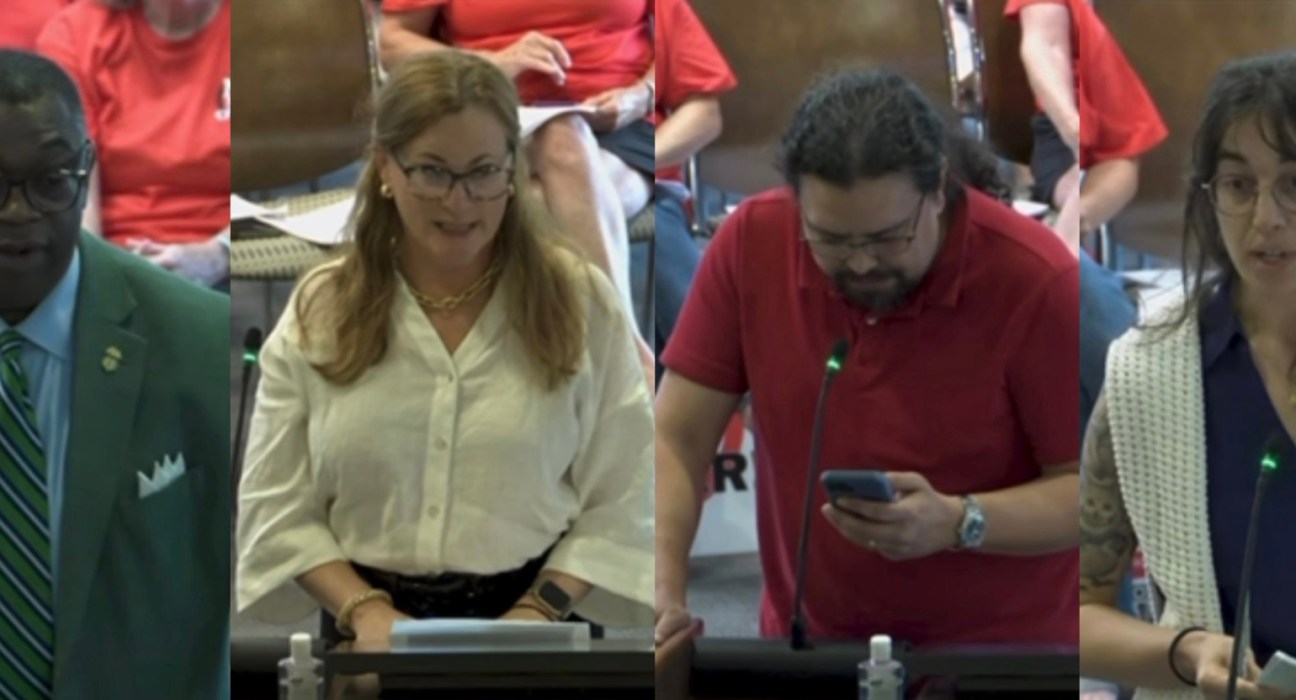

Residents and Muscogee County Sheriff Greg Countryman voiced differing perspectives on the Muscogee County Sheriff’s Office’s participation in the federal 287(g) program during Tuesday’s Columbus City Council meeting.

The discussion centered around the Sheriff’s Office entering into a memorandum of agreement with the U.S. Department of Homeland Security under the 287(g) Task Force Model, which allows specially trained local law enforcement officers to perform certain immigration enforcement functions while working with federal authorities.
Several residents raised concerns about transparency, civil liberties and the potential impacts the agreement could have on immigrant communities, while Sheriff Greg Countryman defended the decision as an intelligence-gathering tool aimed at combating cartel activity and violent crime.
Ric Rivera, who identified himself as a District 8 resident, expressed opposition to the agreement and questioned what authority it grants local deputies. Rivera voiced concerns about immigration enforcement practices occurring nationwide and said residents deserve answers regarding how the program will be implemented locally.
“So what are the terms of this deal?” Rivera asked. “What incentives are they offering, and what do we owe them in return?”
Rivera said he worries residents could fear interactions with law enforcement because of the agreement.
“When an agency gains new power, we have to assume they intend to use it,” Rivera said. “I can’t be quiet when our sheriff signs a memorandum saying he agrees with that.”
District 7 resident Monica Watley said she has requested a copy of the signed agreement and questioned why the Sheriff’s Office needed to enter into the new arrangement. Watley said she reviewed the template Task Force Model agreement available through ICE and found that she did not believe it focused on criminal investigations or criminal arrests.
“Please help me understand,” Watley said. “Sheriff Countryman, I welcome you to meet with me or let us know what’s going on in this agreement because I don’t see anything about criminal investigations and criminal arrests.”
Watley also shared comments she said were submitted by members of the immigrant community who were too afraid to speak publicly at the meeting. Those comments described fears of interacting with law enforcement, uncertainty over the agreement’s scope and concerns about racial profiling.
“If this is all about making our community safer, I ask safer for whom?” Watley said. “Forgive me for not believing the sheriff when he says nothing is going to change.”
Amy Spencer, a District 8 resident, raised concerns about the Task Force Model itself, noting that it was discontinued in 2012 before being revived by the current administration. Spencer questioned whether the current training requirements are sufficient and warned that the program could increase the likelihood of racial profiling.
“What is happening in our country is a humanitarian crisis,” Spencer said.
Spencer also invited city leaders to participate in monthly town hall meetings being organized by Columbus Georgia Indivisible, which she described as a nonpartisan organization focused on civic engagement and community issues.


Sheriff Greg Countryman addressed the concerns during the meeting, saying many of the claims about the agreement do not accurately reflect how the Muscogee County Sheriff’s Office intends to use the program.
“The 287(g) program in which we entered into is not what you just heard,” Countryman said.
Countryman said the Sheriff’s Office entered into the agreement primarily to gather intelligence related to cartel activity and other serious crimes. He pointed to major drug seizures conducted by the Sheriff’s Office over the past six years and said criminal organizations remain active within the community.
“That’s the main reason for this,” Countryman said. “We have some problems in our community and we’ve had issues with cartel members within our community.”
According to Countryman, only eight employees within the Sheriff’s Office volunteered for the program, including five supervisors and three investigators. He added that several of those employees are Hispanic.
Countryman emphasized that deputies will not be proactively seeking undocumented individuals in the community.
“You will not see the Sheriff’s Office going out and looking for individuals that are undocumented,” Countryman said. “We’re not looking for new customers. We want the worst of the worst.”
During questioning from District 1 Councilor Simi Barnes, Countryman explained that the agreement allows investigators to access additional intelligence when dealing with dangerous individuals who may have ties to cartels, human trafficking or violent crimes committed outside the United States.
“The only thing that this does is that it allows us to gather intel,” Countryman said.
He added that intelligence sharing can provide investigators with information that local agencies otherwise would not have access to when conducting criminal investigations.
“It’s not something that needs to be sensationalized,” Countryman said. “This is business as usual for us. Nothing new, nothing added to it.”
Countryman said public safety remains his primary responsibility as sheriff and reiterated that the agreement is intended to help combat serious criminal activity rather than conduct broad immigration enforcement operations.
The discussion highlighted the divide among residents regarding the 287(g) agreement, with supporters emphasizing intelligence-sharing and public safety benefits while opponents continue to raise concerns about transparency, civil liberties and the program’s potential impact on immigrant communities.